Credits and trade
Best Way to Make Credits in Nullbelt
Compare Nullbelt credit sources through activities, trading and ventures. Account for timers, risk and costs before choosing your next earning goal.
On this page
The best way to make credits in Nullbelt is to keep every activity running on its own timer, always run the newest option you've unlocked, and add trading, ventures and later concessions on top. This page compares every credit source, with the timers, risks and costs that decide what you actually keep.
Credits can't be bought with money, so every credit in the Belt was earned by someone. For the other currencies, see Nullbelt Currencies: Credits, Flux, Renown and Rounds.
Early credit routine#
Your first hours set up everything else. In order:
- Run all four activities at once. Jobs, the Sim Deck, Salvage and Hab cracking each have their own cooldown, so they don't compete for time. Tap whatever is ready, then come back. The Sim Deck pays no credits, but its stats raise your chances on the others.
- Pay off the ship loan early. While it is open, 20% of the credits your activities pay goes to the yard. The loan is ₡1,200, with no interest, and every credit you pay toward it brings back your full pay sooner.
- Run the newest option. Within each activity, the option you unlocked most recently is marked Risky, but it pays the most per minute (see below).
- Fill your gear slots. Gear adds percentage points to your success chance, which is the same as a raise. Hab cracking is where gear drops. See Nullbelt Gear and Items: Stats and Equipment.
- Sell, but don't dump. Spare ship parts and gear sell to the station vendor. Cinder pays more for parts, Meridian more for gear. But hold back parts you need for ship refits, contract deliveries or the Broker's deals, which pay well above vendor value.
- Bank as you go. See the last section.
Expected rewards and risk#
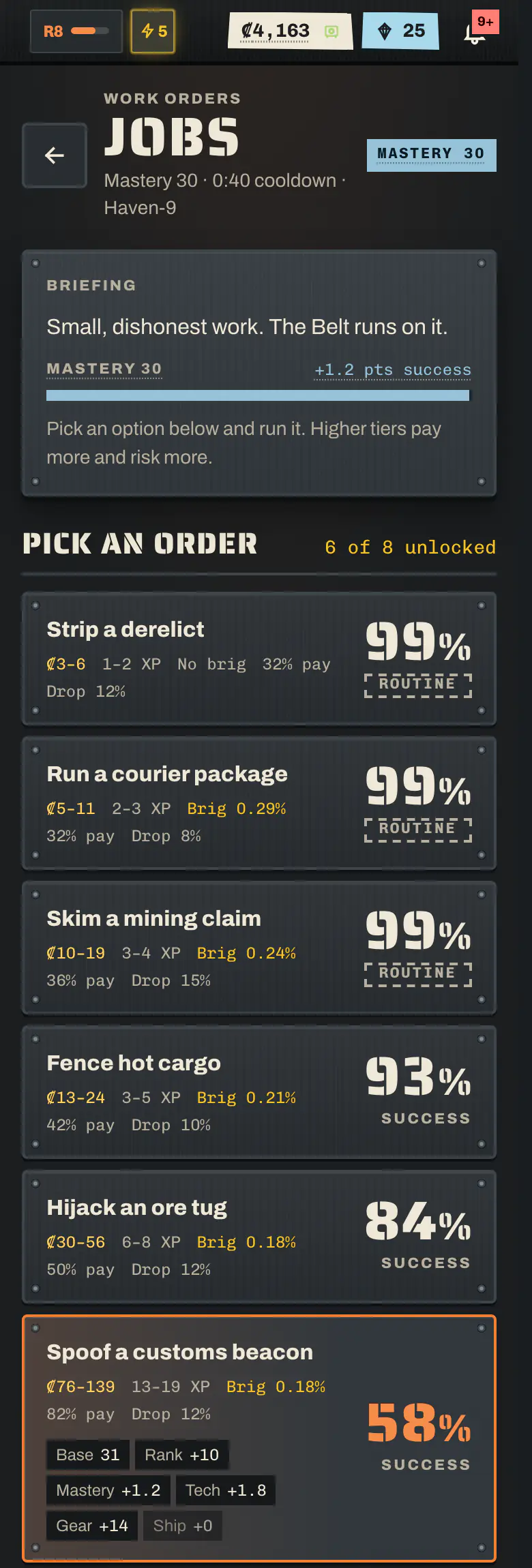
Every option card shows its success chance, what a success pays now, and its pay share. That's enough to work out what an option is really worth:
credits per minute = success chance × average pay on success × pay share ÷ cooldown in minutes
The pay on the card is already after your pay share, so if you use it, leave the pay share out. While the ship loan is open, take another 20% off.
Then subtract what failures cost you: brig time (when you can't run anything) and hull damage, which you repair at the Clone Bay for credits or wait out.
| Option | Opens at | At unlock | +3 ranks |
|---|---|---|---|
| Strip a derelictJobs | Rank 1 · Drifter | ₡496 | ₡463 |
| Run a courier packageJobs | Rank 2 · Scrapper | ₡849 | ₡803 |
| Skim a mining claimJobs | Rank 3 · Hauler | ₡1,260 | ₡1,224 |
| Fence hot cargoJobs | Rank 4 · Runner | ₡1,370 | ₡1,331 |
| Hijack an ore tugJobs | Rank 5 · Smuggler | ₡2,539 | ₡2,539 |
| Spoof a customs beaconJobs | Rank 7 · Corsair | ₡3,655 | ₡3,773 |
| Lift a payroll droneJobs | Rank 10 · Captain | ₡4,577 | ₡4,805 |
| Ghost a corporate freighterJobs | Rank 13 · Overlord | ₡5,298 | ₡6,088 |
| Strip a lifeboatSalvage | Rank 1 · Drifter | ₡91 | ₡85 |
| Gut an ore haulerSalvage | Rank 3 · Hauler | ₡177 | ₡170 |
| Crack a reactor shellSalvage | Rank 5 · Smuggler | ₡285 | ₡285 |
| Tow a dead freighterSalvage | Rank 7 · Corsair | ₡378 | ₡397 |
| Raid the ship graveyardSalvage | Rank 10 · Captain | ₡421 | ₡442 |
| Loot a dead warshipSalvage | Rank 13 · Overlord | ₡564 | ₡648 |
| Pick a crew bunkHab cracking | Rank 1 · Drifter | ₡296 | ₡277 |
| Crack a supply lockerHab cracking | Rank 3 · Hauler | ₡491 | ₡471 |
| Rob the foreman's suiteHab cracking | Rank 5 · Smuggler | ₡860 | ₡848 |
| Breach the med bayHab cracking | Rank 8 · Enforcer | ₡1,196 | ₡1,255 |
| Loot an executive habHab cracking | Rank 11 · Commodore | ₡1,365 | ₡1,433 |
| Vault the governor's suiteHab cracking | Rank 14 · Warlord | ₡1,753 | ₡1,933 |
The table leaves out mastery, stats and gear, which add a few points of chance on a fresh option, so a typical pilot earns a little more than shown. It also leaves out brig time and repairs. For each activity, the game's own pacing model checks that the newest option pays at least as much per minute as any older one, brig time included.
Why the newest option wins#
The game is tuned so that new work is risky and outgrown work is routine. An option you unlocked today fails more often than it succeeds; one you outgrew several ranks ago succeeds almost every time. But outgrown work pays only a share of its listed reward, shrinking with every rank you climb past it. The result: the newest option you can run pays the most per minute, even after failures and brig time. Gear and a better ship lift its chance further: the best kit for your rank takes a fresh option from about 37% to 50–58%.
Brig chances per failure are small. The pacing model gives an active player about one sentence every two and a half to five hours of play, not one an hour.
Every credit source compared#
| Source | Opens | How it pays | The catch |
|---|---|---|---|
| Jobs | From the start | The most credits per minute of the solo activities, on the shortest cooldown | Small sums per run; occasional brig |
| Hab cracking | From the start | Big payouts per run, plus gear and commodity drops | A long cooldown and the highest brig risk per run of the solo activities |
| Salvage | From the start | Small credits; mostly ship parts | Parts are worth more kept for refits or sold to the right buyer |
| Rank grades | Every grade inside a rank | A credit bonus that grows with your rank, plus Renown | Paid once per account; a new life doesn't pay it again |
| Trading | From the start | Profit between stations, or from patient limit orders | Fees, fuel and the stall spread eat thin margins (below) |
| Ventures | From Rank 3 · Hauler | Passive income into a till | Costly to buy; the till caps; lost on a final death |
| Concessions | From Runner | A share of a station business's takings for a day | A sealed bid that is burned whether you win or lose; a flatline loses it |
| Shakedown | From Gunhand, verified | A share of the credits on hand of a random pilot at your station, and some rounds; what it pays depends on the mark | Prime, Stims and Overclock never shorten it; the highest brig risk per run |
| Flatline loot | From Gunhand, verified | Every credit the victim carried | Costs rounds and a daily attack; many pilots bank their wallet |
| Daily contracts | From the start | Renown and items, not credits | Not a credit source |
| Lottery and casino | Lottery from Rank 3 · Hauler; casino at Haven-9 | Prizes and wins | The lottery burns 20% of every ticket and the casino keeps a 5% edge, so on average you lose credits |
| Activity | Opens at | Cooldown | Options | Rewards on success | Risk on failure |
|---|---|---|---|---|---|
| Jobs | Rank 1 · Drifter | 40 s | 8 |
|
|
| Sim Deck | Rank 1 · Drifter | 1 min | 3 |
|
|
| Salvage | Rank 1 · Drifter | 2 min 30 s | 6 |
|
|
| Hab cracking | Rank 1 · Drifter | 6 min | 6 |
|
|
| Shakedown | Rank 6 · Gunhand | 10 min | 2 |
|
|
Shakedowns and combat loot#
From Gunhand, with a verified account, the Shakedown robs a random pilot in your rank band at the same station. It takes a share of their credits on hand, up to ₡6,500, and some of their rounds. How much you get depends on how much your mark carries. Its cooldown is the longest of all the activities, and nothing you pay for shortens it: not Prime, a Stim or an Overclock.
A flatline takes everything the victim had on hand. Every public profile shows a pilot's credits on hand, so you can pick a target worth the rounds. But your attacks a day are limited by your ship, rounds cost credits, and a pilot you rob or kill goes looking for you on their Grudges list. Treat combat loot as a bonus, not a salary. See Nullbelt Shakedown Guide: Rob Pilots for Credits and Rounds and How Combat Works in Nullbelt: PvP Explained.
Concessions#
Every day at 18:00 UTC, station businesses go to a sealed, first-price auction. The winner earns a share of what players spend there until the next auction. A pilot can hold at most 2 at a time; the armouries, the Cinder scrapyard and the Meridian clone bay open from Runner, and the market halls and the casino from Smuggler. The Dock Authorities are for crews only.
Every bid is burned, win or lose. A concession is a bet that players will spend more there than you bid. The previous term's winning bid and the current term's takings so far are public, so check them before you bid. If you are flatlined while holding one, you lose it and its till, even if Clone Insurance brings you back. See Nullbelt Concessions: Daily Auctions for Station Businesses.
Trade after costs#
Trading can be steady money, but only once you count every cost:
profit = units × (sell price − buy price) − taker fees − fuel − docking fee
- Fuel on every departure grows with each commodity unit aboard, so every unit you haul has to earn its own fuel. You can burn fuel cells from your hold instead of credits.
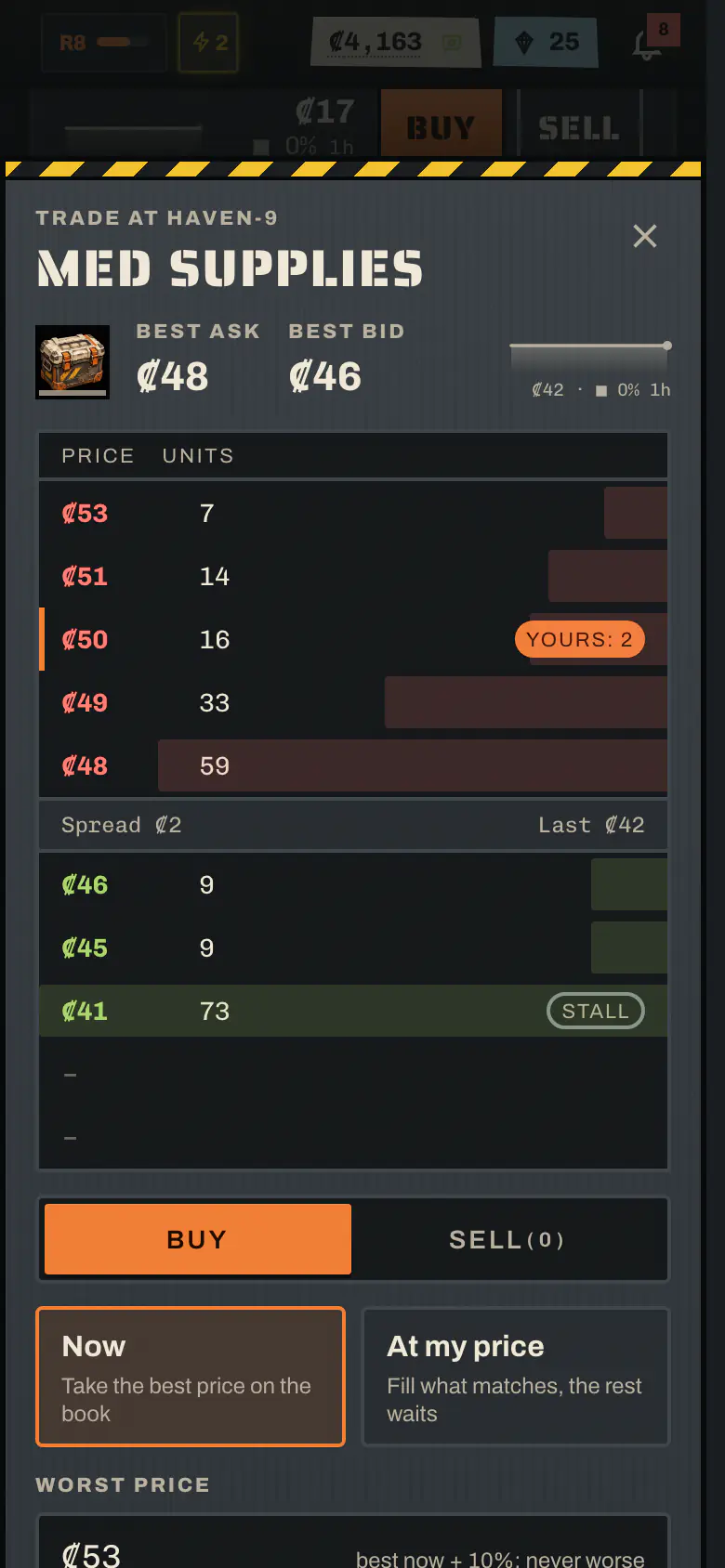
- The taker fee (2% of the filled value) is paid only by the order that crosses the book. A limit order that rests and fills later pays nothing.
- The stall spread. Each station's stall sells above and buys below its centre price.
Warning
Buying from one station's stall and selling to another station's stall usually loses money on cheap goods: you pay both halves of the spread, a taker fee twice and the fuel for every unit. It works only on goods with a wide price gap between stations.
What works better:
- Rest limit orders. Post a buy just above the best bid at a station that supplies a commodity, and a sell just below the best ask where it is wanted. Orders inside the stall's spread always fill before the stall, and a resting order pays no fee.
- Follow station character. Cinder supplies ore, tech scrap and void dust, which Meridian wants. Meridian supplies water ice, fuel cells and med supplies, which Haven-9 wants.
- Keep what you use. Burn fuel cells for fuel and med supplies for hull repairs instead of selling them and paying credits later.
- Void dust pays the most at Meridian, but customs there can seize it and jail you. On average the risky run pays more than the safe one.
Trading income is never taxed by your crew: the crew tax applies only to earned income, which means activity pay, shakedown takings, venture tills, a concession till you collect and flatline loot.
The full playbook is in the Nullbelt Trading Guide: How to Make Credits Trading, and the order book itself is explained in The Exchange: Nullbelt's Player Order Book Explained.
Venture payback#
A venture is a business you buy at a station: a scrap stall, an ice refinery, a cantina and more as you rank up. Each one fills a till with credits every hour, and some also produce goods.
- Payback. A first-level venture is tuned to pay back its price in a few days if you collect it about twice a day. Each upgrade takes longer to pay back.
- The till caps. It stops filling after a number of hours without a collection (the first venture's first level fills for 8 hours), so a venture you never visit earns nothing more.
- Collect in person. You collect at the venture's own station, docked and out of the brig. The credits land on hand, so bank them.
- Not a replacement for play. Every venture you can own, fully upgraded, earns well under half of what active play earns at the same rank.
- Death and speed-ups. A final death loses your ventures; a Clone Insurance revival keeps them. Prime and Overdrive don't speed them up.
Buy your first venture once the ship loan is paid and you have some savings, at a station you pass through often. See Nullbelt Ventures: Passive Income and Upgrades.
Protect your earnings#
Making credits is half the job; keeping them is the other half.
- Bank what you won't spend soon. Credits on hand are public on your profile and are what a killer or a shakedown takes. Banked credits can't be looted. A deposit costs 5%, and withdrawals are free. See Nullbelt Bank: Deposits, Fees and Death.
- Before Gunhand nobody can attack or rob you, so it's the cheapest time to save up.
- Plating and a sturdier ship raise the rounds needed to flatline you, which makes you a worse target.
- Know your crew's tax. A crew can take up to 25% of what members earn. The rate is public, and a raise needs a day's notice unless the crew pays to bring it forward.
- Skip the gambling if you want to grow your credits. The lottery burns part of every ticket and the casino keeps an edge.
- Death isn't the end of your savings. If your pilot dies for good, 25% of its bank, up to ₡50,000, passes to your next pilot. See Nullbelt Death, Legacy and Clone Insurance.
For where credits come from and go across the whole economy, see Nullbelt Economy: Where Credits Come From and Go.
Frequently asked questions#
What is the fastest way to earn credits in Nullbelt?
Keep every activity running on its own timer, and in each one run the newest option you have unlocked: it is the riskiest, but it pays the most per minute. Of the solo activities, Jobs earns the most credits per minute, Hab cracking comes next, and Salvage pays mostly in ship parts. Pay off your ship loan early so none of your pay is diverted.
Can I buy credits with real money?
No. Credits are only earned in the game. Flux, the premium currency, never converts to credits.
Are ventures worth buying in Nullbelt?
Yes, as a long-term extra, not a replacement for activities. A first-level venture pays back its price in a few days if you collect it about twice a day, but its till stops filling when it is full, you must collect at its station, and a final death loses it.
Should I bank my earnings?
Yes, whatever you don't plan to spend soon. Credits on hand are public on your profile and can be taken in a flatline or a shakedown. Banked credits can't be looted, at the cost of a small deposit fee.