Combat
How Combat Works in Nullbelt: PvP Explained
Learn how asynchronous PvP works in Nullbelt, including rank bands, station checks, protection, daily attacks, rounds and persistent hull damage.
On this page
Nullbelt combat is asynchronous PvP: you pick a pilot docked at your station, fire a volley of rounds, and a public formula decides at once whether they are flatlined (killed) or only lose hull. The target does not need to be online, and there are no dice. This page walks through the attack flow, every factor in the formula, a worked example, what each side gains or loses, and how hull damage is repaired.
The attack flow: hunt, scan, strike, report#
Combat opens at rank 6 (Gunhand). Below that rank nobody can attack you and you cannot attack anyone. Buying rounds is open to everyone, so you can stock up before you get there.
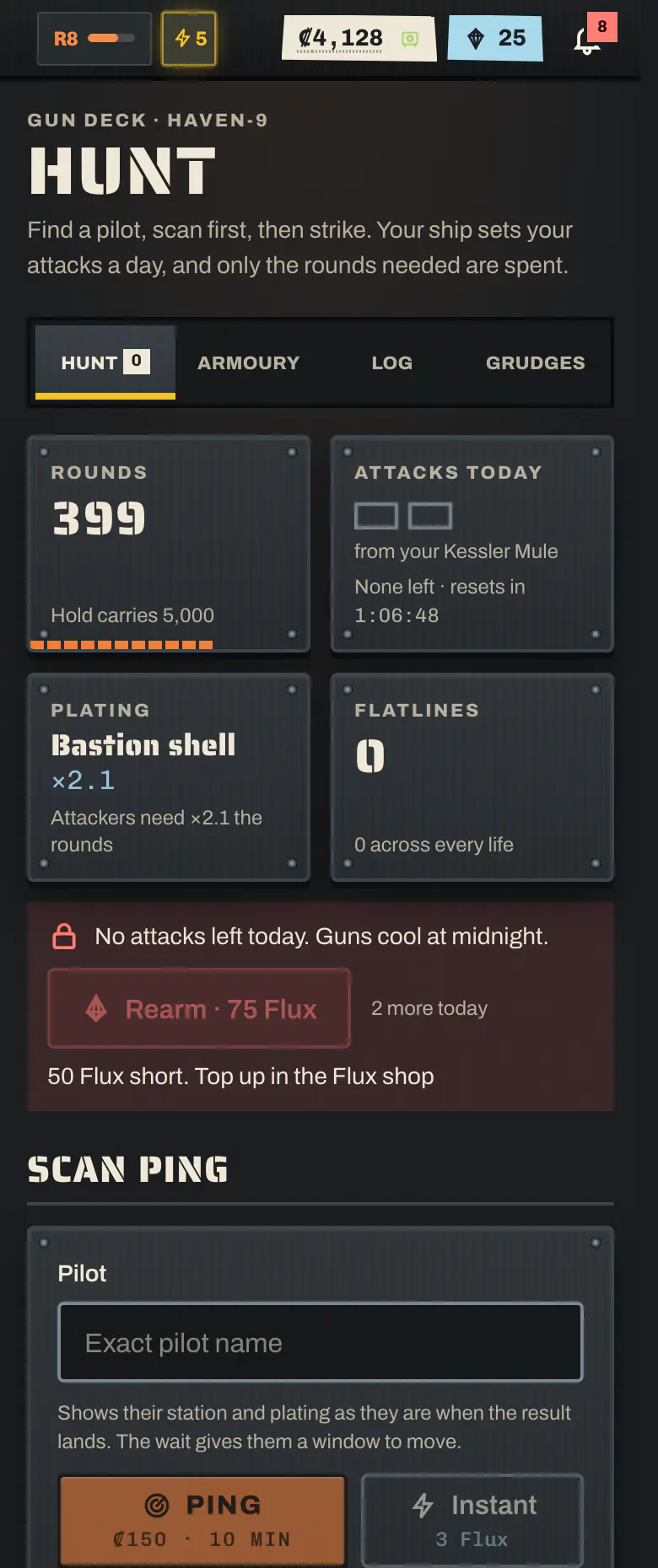
- Find a mark. Open Fight → Hunt. You can ping any living pilot by their exact name, whatever their rank. Good leads are your Grudges tab, the Pilots boards and public profiles, which show a pilot's rank, gear, the ship they fly (with its refit levels and modules), credits on hand, rounds carried and how recently they were active.
- Scan them. A scan ping costs 150 credits and lands after 10 minutes, or 3 Flux for an instant result. The Renown scan boost halves either price. It shows their station (or that they are in transit) and their plating tier as they are when the result lands. The wait gives them time to move. You scan from a station: docked and out of the brig. The target is never told.
- Go to them. The target must be docked at the same station as you. If the scan says they are elsewhere, fly there first.
- Line up the attack. The strike screen checks everything before you fire: your rank, their rank band, crew, your hits on them today, your attacks left, your rounds, and whether you are docked and out of the brig. See attack rules for each check.
- Fire. Choose how many rounds to fire, from 1 to 5,000. Only the rounds needed are spent, so firing everything you carry wastes nothing. The attack uses one of today's attacks either way.
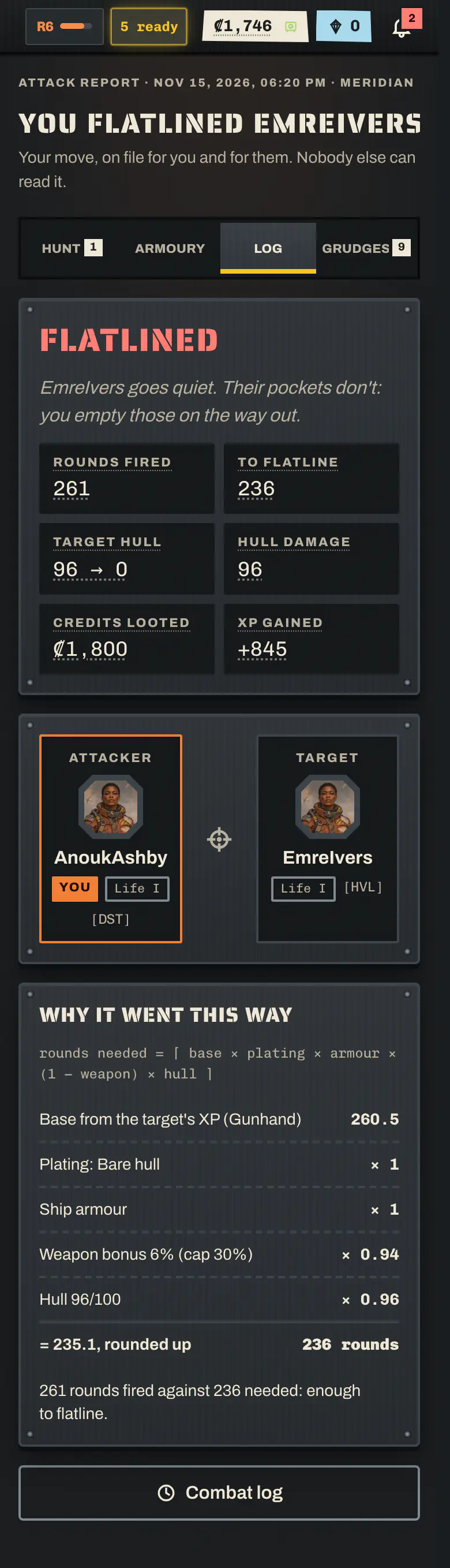
- Read the report. You get an incident report at once. A target who survives gets a notification that opens the same report. A flatline is posted on the station's Notice board.
Tip
Your first volley at a new target reveals the exact rounds needed. After that, the strike screen shows an estimate from your last volley, adjusted for the hull they had left.
The Nullbelt combat formula: what decides the outcome#
Every attack computes one number: the rounds needed to flatline the target right now. Fire at least that many and the target is flatlined. Fire fewer and they lose hull.
rounds needed
  = ⌈ base × defence × weapon × hull ⌉

base    = (target XP × 8)^0.7 ÷ 15
defence = plating × ship armour
weapon  = 1 − weapon bonus ÷ 100
hull    = target hull ÷ 100
The result is rounded up and is never below 1.
| Factor | What it is | Who controls it |
|---|---|---|
| base(target XP) | Grows with the target's total XP, not their rank number. Two pilots of the same rank can need different amounts. | The target, by ranking up |
| Plating | The target's plating tier, bought at the Armoury. It runs from bare hull (×1) to null plate (×3.6). | The target |
| Ship armour | The armour of the ship the target is flying: the hull's own armour plus armour refits. It multiplies the plating. | The target |
| Weapon bonus | The attack bonus on your equipped weapon, plus your ship's attack bonus (gunship trait and hardpoint modules). Each point is one percent fewer rounds, capped at 30%. | You |
| Hull | The target's current hull out of 100. A damaged pilot needs proportionally fewer rounds. | Earlier attacks and repairs |
Some things do not change the rounds needed:
- Your rank. It only decides which ranks you may target.
- Your stats (aim, grit, tech) and mastery. They help activities, not attacks.
- The plating gear slot. Plating gear (Patch Plating and the rest) helps Salvage and Hab cracking. Only the plating tier from the Armoury counts in combat.
- Prime. It gives no attacks and no combat bonus.
- Luck. The same inputs always give the same result. The attack's random seed only picks the flavour line in the report.
Note
The rounds-to-kill tables, with every rank and plating tier, are on How many rounds to kill.
Worked example#
A Corsair with exactly 28,000 XP (the start of the rank) has bought scrap mesh plating (×1.25), flies a Kessler Mule (armour ×1) and is at full hull.
You carry an Arc Carbine (attack 6) and fly a Brannoc Hound (trait attack 6) with a Scrap Cannon fitted (attack 3).
- Base: base(28,000) = 370.8.
- Defence: scrap mesh × Mule armour = ×1.25.
- Weapon bonus: 15%, under the cap, so the rounds are multiplied by (1 − 15 ÷ 100).
- Hull: 100 ÷ 100 = 1.
- Result: 393.9, rounded up to 394 rounds.
Now say you only fire 200. That is short, so the Corsair lives and keeps the same share of their hull that you were short by: their hull drops to 49. The next volley, from you or anyone else, needs only 194 rounds, as long as the hull has not mended in between.
Hits and flatlines#
| You fire | Outcome | What happens to the target |
|---|---|---|
| At least the rounds needed | Flatline | The pilot is killed. Only the rounds needed are used up; you keep the rest. |
| Fewer than needed | Hit | The pilot loses the same share of their current hull: hull after = ⌊hull × (needed − fired) ÷ needed⌋. A hit always leaves at least 1 hull, so it can never kill. |
- One volley can fire at most 5,000 rounds, and you can carry at most 5,000.
- A hit and a flatline both use one of your attacks for the day and count toward your hits on that pilot.
- Hull damage stays until it mends, so several attackers can wear down one tough target. Each of them needs fewer rounds than the last.
- If two pilots attack the same target at once, the attacks run one after the other. Once the target is flatlined, the others are told the pilot is gone and keep their rounds.
What the attacker gains and what the victim loses#
| On a hit | On a flatline | |
|---|---|---|
| Attacker | Spends the rounds fired. | Gets 5% of the victim's XP (raised by an XP booster: Legacy or a recruit's welcome kit), every credit the victim had on hand, and a kill on their public record. The kill is posted on the Notice board. |
| Victim | Loses hull. Gets an "attacked" notification with the report. | Loses every credit on hand to the killer, and the pilot dies. Unless Clone Insurance revives it, the death is final: rank, XP, cargo, gear, plating, the rounds they carried, and their credit-bought ships and modules go with it. |
- Banked credits are never looted. The killer only takes credits on hand.
- Rounds are not looted. The killer never gets them. Only a Shakedown takes rounds from another pilot.
- Clone Insurance (Prime) can revive a flatlined pilot once per life within 48 hours, with everything except the credits on hand, if Prime was active at the death and no new pilot has been started. The killer keeps the loot and the kill.
- The account keeps Flux, cosmetics, its profile and Renown. The full aftermath, including Legacy, the estate and Clone Insurance, is on Death and Legacy.
- Attacking anyone ends your own new-pilot protection at once.
- If your crew taxes income, flatline loot is taxed like any other earnings.
Hull damage and repair in the Clone Bay#
Hull runs from 0 to 100, and every pilot starts at full hull. In combat, your current hull scales the rounds an attacker needs, so a pilot at half hull needs about half the rounds.
Damage from attacks (and from failed Salvage, Hab cracking and Shakedown runs) mends in the Clone Bay:
| Way to repair | Cost | How much |
|---|---|---|
| Wait | Free | 5 hull every 15 minutes, on its own, wherever you are (twice as fast with the Renown Clone Bay boost) |
| Credits | (2 + 1 × (your rank − 1)) credits per missing point | Full hull at once |
| Flux | 5 Flux, whatever the damage | Full hull at once |
| Med supplies | Units from your hold, no credits | 30 hull per unit. The bay uses only as many units as the damage needs |
| Med-gel | One Med-gel item | 25 hull |
Paid repairs (credits, Flux, med supplies) need you docked and out of the brig.
Failed activities never take your hull below 10, but an attack can take it down to 1.
Tip
Repair before you fly to a busy station. Med supplies are often the cheapest repair: a unit mends more hull than the credits it would fetch at a stall.
Defending yourself#
Everything that makes you harder to flatline is a factor in the formula: more XP, a higher plating tier, a ship with more armour, and full hull. Everything that makes a flatline cost you less is outside it: bank your credits and keep spare rounds in your crew armoury. The full checklist is on Dying in combat.
Frequently asked questions#
Does the target have to be online when I attack?
No. Nullbelt combat is asynchronous. The target only has to be docked at your station, inside your rank band and not protected or in the brig. They find out afterwards from a notification and the attack report.
Is there any luck in a Nullbelt attack?
No. Whether a volley flatlines the target or only damages it comes from a public formula with no dice. The only random part is which line of flavour text the report shows.
Does my own rank change how many rounds I need?
No. The rounds needed depend on the target's XP, plating, ship armour and current hull, and on your weapon bonus. Your rank only decides who is inside your band.
Do I lose the rounds I fire beyond what was needed?
No. Only the rounds needed to flatline the target are used up. If you fire more, the rest stay in your hold.
What happens to the hull damage after a hit?
It stays on the target until it mends in the Clone Bay, so the next attacker needs fewer rounds. Hull repairs 5 points every 15 minutes on its own, or at once for credits, Flux or med supplies.
Does a flatline always end my pilot?
Only if nothing revives it. Clone Insurance, part of Prime, can bring a flatlined pilot back once per life within 48 hours, if Prime was active when the pilot died and the account has not started a new pilot since. Otherwise the death is final.